 Pete Guzzo
Twenty years of production. A system of AI agents built to run the other half of it.
Here's the part nobody says out loud: I'm not trying to replace editors, and I couldn't if I tried. The problem is everything underneath that job. Nobody wants to log footage, organize a project, or build a sequence anymore — not at a rate any real client budget covers, and I don't have the hours to do it myself either. Meanwhile every client expects a rough cut that already looks finished. So I built the crew I couldn't hire. I designed it, I built it, I run it: CORTEX.
AI will never replace a human. It replaces the human who won't work with one. Everything on this page is me figuring out how to build better jobs for humans in production — not fewer of them.
What CORTEX is
My AI architecture, not a single tool.
CORTEX is the operating system I built and run underneath everything on this page. It's not one assistant. It's a team of named AI agents, each with one defined job, a supervisory layer that coordinates them, and a memory that persists across sessions instead of resetting every time. One rule never moves: nothing publishes, ships, or spends under my name without me checking it first.
Two decks run inside it at the same time: the physical production side and the AI system side. They're not separate projects. They feed each other.
The physical side
Production
- Two decades directing and producing film, documentary, and television
- National advertising, nonprofit, and branded content
- Award-winning work recognized nationally
- Built and run Shear Media Studios, about 15,000 sq ft, in St. Petersburg, FL
- Closed and run the Barstool Sports contract, a recurring weekly live broadcast, sold on the strength of the studio
- Developed 211 Studio, Channelside, now home to the episodic series A Land Remembered
The system side
CORTEX
An operational intelligence system built around named AI agents with defined roles, a supervisory layer, and a human approval gate that doesn't move. Nothing ships without me. One agent trying to do every skill and every task doesn't work — same reason you don't make one person your graphic designer, your developer, and your financial analyst. Specialists don't grind as hard, and stacking too many jobs on one agent is exactly where hallucinations and mistakes creep in, because nobody's tracking where it actually is in the work. So the roles are split instead, and how many agents a job gets depends on what the job needs. The Verse alone runs seven, each with exactly one job.
- This site was built by the system it describes. See the full build chain.
- Seven roles inside The Verse alone, each with exactly one job — covered role by role below
- Security and risk checks are their own lane. Agent 69 and his security system, ARGUS, handle that, so the rest of the team doesn't have to think about it
- One agent, Missy, keeps the canonical record and backups straight, and keeps every agent in line
- Verified-claims discipline: no fact enters copy without a traceable source
- Memory that persists across sessions instead of resetting every time
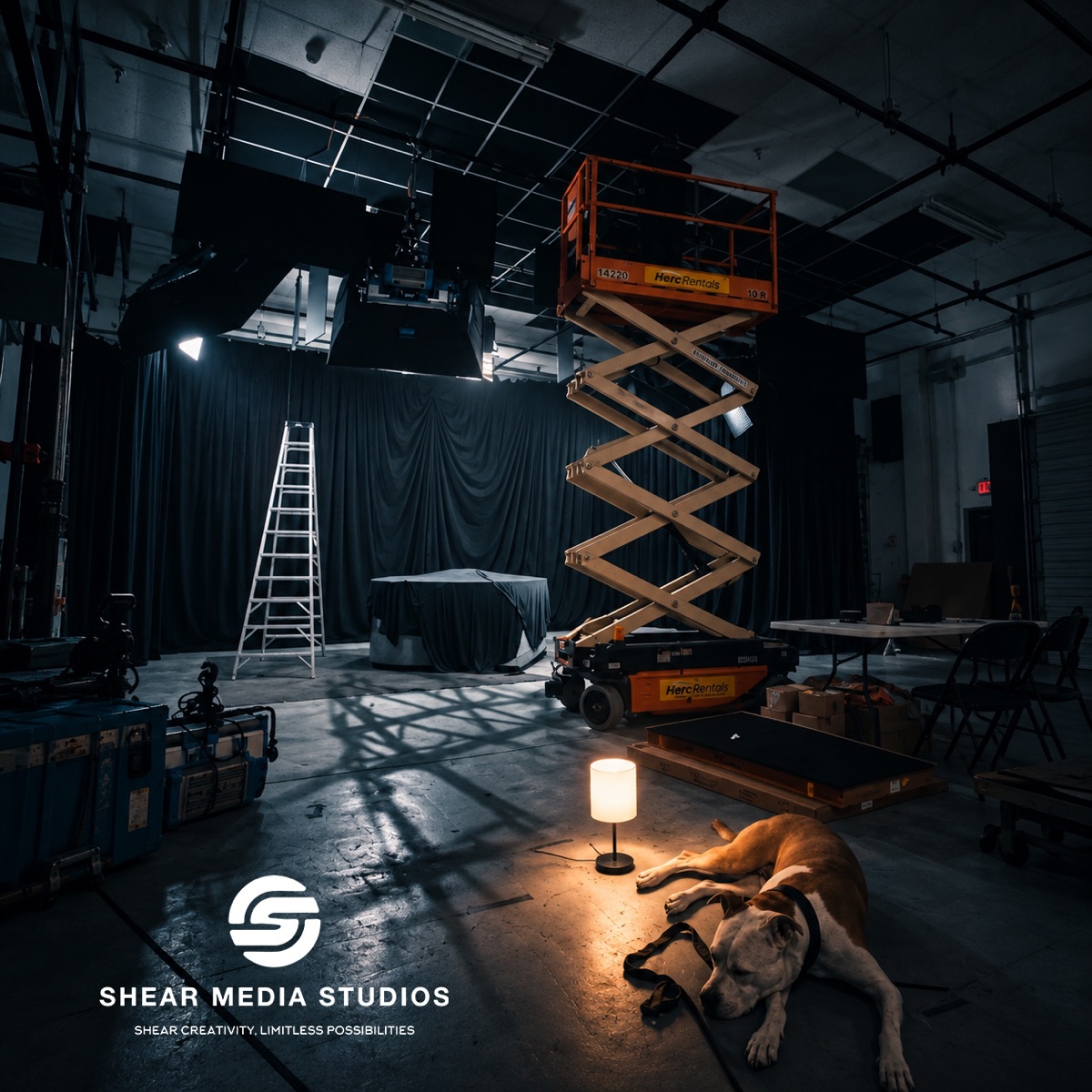
Studio G, Shear Media Studios, St. Petersburg FL
Inside CORTEX
The Verse: an assistant editor. Not the editor.
It gets the job started before I ever open a timeline — organizing the footage, syncing it, taking a first pass on audio. And it closes the job out after I've cut the story — rendering, repackaging for three screen shapes, finishing, QC. Everything in between, the actual edit, is still only mine.
It's not one agent doing all of that either. It's split the way a real crew is split — the person indexing footage isn't the person mixing audio, and the person mixing audio isn't the person doing color. Each job gets its own specialist, same as it would with people.
Seven roles, not one agent doing everything
Junior
Scout
Echo
Fader
Luma
Pixel
Gate
Pete
One project, every shape
Vertical cut for social and mobile
Widescreen master
Full-runtime cut, broadcast length
Same source footage, same story, three deliverable shapes, built from one timeline instead of three separate edits.
Still the one in the chair
Can it get close to a full edit? Yeah, pretty damn close. Is it exactly what I want as the editor and the director? No — because I still have to walk in and tell it exactly what I'm looking for. The Verse doesn't decide what the story is. I do. That never leaves the human.
I can still open Premiere or DaVinci myself and cut, the same way a mechanic who's automated most of his diagnostics can still pop the hood. I just don't have the time anymore. My one job turned into five, and nobody wants the other four.
Why it exists, and how it actually runs.
Long-form documentary, reality, interview, and social work carries a huge mechanical burden before a single creative decision gets made: organizing hours of footage, syncing separate audio, transcribing, finding the one quote, finishing in multiple formats. This removes that burden so the decisions happen faster, not instead of happening.
The mission order
Every stage hands off a versioned output plus a receipt: source, assumptions, sync evidence, restoration and mix notes. A picture revision has to match its graphics and audio receipts before QC passes it. Originals never get touched. Material gets tagged by how real it is: a spontaneous moment, a producer-fed pickup, a staged setup. Nothing is presented as more candid than it actually was. Nothing invents a quote, manufactures a timeline, or cuts context to make a clip hit harder.
How it actually checks its own work
Footage becomes a searchable index before anyone edits a frame. Every shot gets tagged by mood, person, and quality rating. Every spoken line gets mapped back to its source, timecode, and sync confidence. Story choices get made from that index, not from whatever happened to be handy.
Every picture version carries a revision ID generated from its own contents. Its graphics, audio mix, and QC receipts have to carry that same ID or the delivery gets rejected as stale. A new aspect ratio, a new grade, a new music swap, each gets its own ID. Older versions get archived, never overwritten, so nothing is a one-way door.
QC runs on measurement, not a gut check: frame counts and audio length checked against picture, loudness and true-peak measured on the final encode, automated checks that titles and captions never collide with a face, a shake/blur score on every cutaway that flags anything too rough to use. Camera-to-recorder sync gets verified at the start, middle, and end of a take, not assumed. And the check is never done by the same agent that built the thing being checked.
What stays human, full stop
- Final story meaning
- Sensitive edits
- Final creative selection
- Any material claim
- Rights exceptions
- Irreversible changes
- Publishing, and spending
"The target is not an automated video. The target is a human editor with extraordinary leverage."
What it's built toward, not what's shipped yet, is a full workflow application with its own modules for source registry, sync, transcripts, a searchable bite bank, B-roll retrieval, native Premiere and Resolve support, review and approvals, QC evidence. Export packages for Premiere and Resolve exist and validate offline. A live bridge into the edit applications exists too, but the first real import through it isn't verified working yet. That part's still in development, and I'd rather say so than claim it's finished.
Inside the Verse.
Not the footage. None of that's public, and won't be. The process.
Most of what exists right now, footage indexes, paper edits, QC sheets, overlay graphics, carries identifiable client and guest information, so none of it is going on this page. What does get shown here is held to one standard: no faces, no names, no story IDs, ever. A real before/after spectrogram from a dialogue-restoration pass exists and meets that bar; it's queued for this page once the last review pass on it is done.
Inside CORTEX
The Review Desk.
The actual tool I use to review footage and leave timecoded notes. Local-first — nothing leaves this computer.
Timecoded notes
3 notes
Audio drifts slightly against picture here. Flag for Echo.
Caption overlaps a face in this frame. Needs a reposition pass.
Color match confirmed against reference shot.
See it in motion
Watch the video.
The Verse, start to finish — not a pitch deck, the actual system.
Inside CORTEX
And on the customer side: Shea.
The Verse is the production-side system. Shea is the customer-facing one, built and maintained for Shear Media Studios.
Shea is an AI chat concierge embedded on shearmediastudios.com. A visitor opens the widget, registers, and talks through what they need: which studio, rough scope, the same conversation a human would have at the front desk. Shea turns that into a structured project brief and routes it to the studio's team for a human to follow up and close. It doesn't book anything, sign anything, or take payment. It qualifies the lead and cuts the back-and-forth before a real booking call ever happens.
Most people don't walk in with a finished brief. They walk in with an idea, a deadline, maybe a reference clip they liked. So Shea asks the same questions I'd ask at the front desk myself: who's this for, what has to actually happen in the room, is this a studio day or does it travel, how many people are on camera, is it a one-off or does it come back every week. Simple questions. They're also the ones that turn "we need a podcast" into something a crew can plan around before anybody picks up the phone.
What a visitor sees, live on shearmediastudios.com
Shea: Hey, welcome to Shear Media Studios. I'm Shea, the studio's AI concierge. What are you thinking about making: a podcast, marketing content, a commercial, a live show, or something else?
Visitor: I need a podcast studio for a weekly show.
Visitor
Shea
Brief
Human
Live now
Shea 1.0
Deployed and embedded on the live site. Registration-gated chat behind four independent rate limits: per visitor, site-wide, per IP, and registrations per IP. Not just one usage cap. Every brief it generates goes out through a message queue with its own dead-letter queue, so a failed email doesn't just vanish silently. Covers real studio spaces and a handful of pricing and add-on rules. Every conversation ends in a brief routed to a human. Nothing closes without one.
In development
Shea 2.0
Staged, not live. On its own Worker, its own data store, its own queues. Zero shared state with production, by design. A confirm-draft flow, an inline comparison panel, a budget-entry tool, and a smarter studio-fit conversation, landing one feature at a time, each its own gated commit, never a big-bang merge to the real site.
Inside CORTEX
One idea, start to finish.
Shea and the Verse aren't two separate systems. They're the front half and the back half of the same chain.
A client brings an idea to Shea. Shea turns it into a brief a human can actually act on. A crew shoots it. From there the Verse takes over: organize, sync, transcribe, cut, finish, in three screen shapes, every version landing in the Review Desk before it goes anywhere. Same chain, same rule the whole way through. Nothing skips a step. Nothing skips me.
Idea
Shea
Brief
Shoot
The Verse
Review Desk
Pete
Delivery
The rest of CORTEX.
The Verse and Shea are the two most visible pieces. They're not the only ones.
The same discipline runs underneath the writing on this site and on Substack: a research pass, a draft pass, and a fact-check pass before anything gets anywhere near a publish button. Nothing goes out under my name without me checking it against what's actually true first.
There's a financial and operations layer that runs the same way: cash flow tracking, forecasting, budget discipline, built on the same rule. A second pass verifies the first, and nothing that touches real money moves without a human sign-off.
And there's a layer above all of it that doesn't touch production directly. It just keeps score. It holds what's been tried, what worked, what didn't, so the next piece of work doesn't start from zero every time. That's not a hypothetical. Four separate factual errors in earlier drafts of this exact page, on the Verse's real role chain and on Shea's real capabilities, got caught and fixed by that verification layer before this page ever reached you. That's the system working as designed, not a failure I'm glossing over.
How it actually got built
Shea came first. Then CORTEX as the system around it. The Verse is the newest piece. None of it came from one tool, and none of it arrived finished. I built it the way you build anything on a tight budget with no engineering department: a little bit from every tool that was actually useful, assembled by hand.
Claude is the core of it. It's what runs the agents day to day, the Verse included. ChatGPT and Codex did real work getting there too: drafting, technical scaffolding, pressure-testing an idea before it became an agent with an actual defined job. Ruflo started as a browser-automation tool, not an agent, and got upgraded into one along the way. That mix is how a handful of tools became a working roster of named agents instead of a pile of disconnected scripts, and it's also why I don't talk about "the AI" like it's one thing. It isn't. It's a team I put together, tool by tool, the same way you'd staff a production.
Why that overlap is the actual pitch.
I've spent two decades being the person who takes complex technical and creative work and makes it make sense to an audience that wasn't in the room when it got made.
I write that translation publicly, too. Long-form articles on Substack about how the production and the systems work actually get done. Research and a first pass get automated help. Nothing goes out that isn't 100% rewritten, grammar-checked, and approved by me before it's public.
And I don't just use AI tools. I design how a team of them is supposed to work together: scoped roles, a verification layer, a human who stays the last approval before anything is final. The Verse, Shea, and the system that writes and builds this website all run on the same principle. Automate the repeatable parts, never the judgment.
If a role these days is really five roles stapled together, you should expect the person in it to automate some of the process. That's not a threat to the craft. That's just what the job actually requires now.
Proof, not a pitch deck
Barstool Sports: live, under pressure.
Barstool Sports runs a recurring weekly live broadcast out of Shear Media Studios. Getting the signal path online wasn't simple, and the AI side showed up in the moment that actually mattered.
Want to see how it's built?
The full CORTEX architecture, the build chain for this site, and the production case studies are all public.
See the system →Pete Guzzo, EVP, Shear Enterprises LLC. Shear Media Studios, St. Petersburg, FL.
Shea vPG
AI assistant, not Pete
Shea vPG: Ask me anything about Pete's production background, AI Production, CORTEX, the Verse, or Shea.
You have 5 questions with this assistant.
CORTEX — Dispatch Model
One request. Seven specialists. One desk.
What actually happens between "Pete sends a note" and "a cut lands in the Review Desk." SPECTRE doesn't do the work itself, it dispatches to named agents, each with one job, and every thread reports back to the same place.
PeteDispatches the note
SPECTRERuns the Verse
JuniorIngest
ScoutStrategy
EchoDialogue
FaderMix
LumaColor
PixelCaptions
GateQC
Review DeskEvery thread lands here